- Jack Spurgin’s Newsletter
- Posts
- How to Overcome Negative Thinking
How to Overcome Negative Thinking
Why Our Brain is Wired for Worry (And What to Do About It)

Jack Spurgin
January 08, 2026
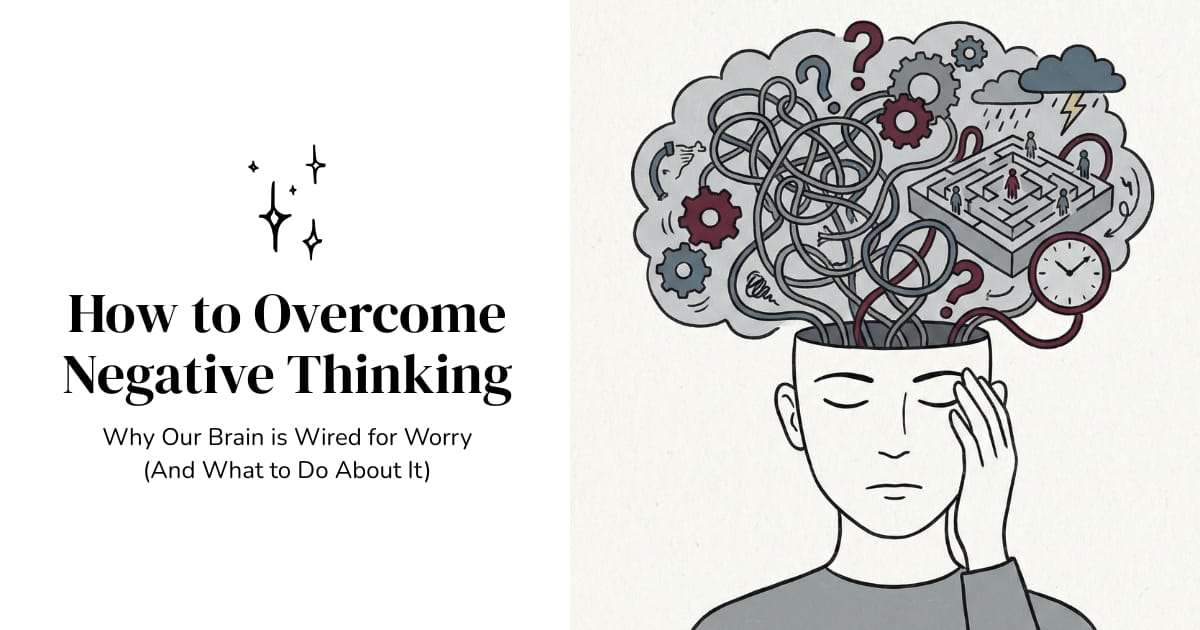
Do you ever notice how one small criticism can ruin your entire day, even if you received multiple compliments? Or how your mind automatically jumps to worst case scenarios before you've even had your morning coffee? Maybe you've caught yourself thinking "I'm not good enough" or "Everything always goes wrong for me" and wondering why these thoughts feel so convincing?
Here's something that might bring you relief: your brain isn't being dramatic or pessimistic. It's actually being protective. The challenge is that it's protecting you from threats that no longer exist in the way they used to.
Let me explain why understanding this changes everything.
Our Brain is Running Outdated Software
Imagine trying to run the latest video game on a computer from 1975. That's essentially what's happening in your head every single day. Your brain was perfectly designed for a world that no longer exists.
About 50,000 years ago, when your brain's operating system was being fine tuned through evolution, humans faced immediate physical dangers. The people who survived long enough to become your ancestors weren't the optimists who assumed everything would be fine. They were the ones whose brains constantly prepared for the worst.
If your ancestor heard rustling in the bushes and thought "Oh, that's probably just the wind," they might have become someone else's lunch. The ones who assumed danger and prepared for threats? They survived, had children, and passed on those cautious, worry prone brains.
So when your mind generates thoughts like "What if I mess up this presentation?" or "Why didn't they text me back?" or "Am I falling behind in life?" it's not being irrational. It's doing exactly what it was designed to do: keeping you hyperaware of potential problems so you can address them before they become threatening.
The issue is that in today's world, most problems aren't actually problems that need immediate solving. They're just thoughts. Mental events. Background chatter from a survival system working overtime in a world it doesn't understand.
The Negativity Bias: Why Bad Feels Bigger Than Good
Psychologists have identified something called the "negativity bias" which shows that negative experiences and thoughts have about five times more psychological impact than positive ones.
Think about your own experience. If nine people compliment your work and one person offers criticism, which comment occupies your thoughts on the drive home? If you have eight pleasant interactions during your day and one awkward moment, which one plays on repeat in your mind before bed? 🌙
This isn't a character flaw. This is your brain doing exactly what it was programmed to do over millions of years. In the ancestral environment, remembering where you almost got eaten was far more important for survival than remembering where you found tasty berries. The berries were nice, but forgetting about danger could literally end your life.
Our brains learned to hold onto negative information like velcro and let positive information slide off like teflon. This means your modern brain is naturally biased toward noticing, remembering, and ruminating on problems, threats, and negative possibilities.
Not All Thoughts Deserve Your Attention
Here's a liberating truth: approximately 80% of your thoughts are mental clutter. They're repetitive worries, meaningless commentary, random associations, rehashing of past events, and imaginary future scenarios that will never happen.
The remaining 20% includes thoughts actually worth your attention: genuine insights, creative ideas, practical solutions, important reminders, and meaningful reflections.
Most people give equal attention to both categories. They spend as much mental energy worrying about hypothetical scenarios as they do planning for real opportunities. They devote as much thought to analyzing an awkward conversation from last week as they do creating solutions for actual current challenges.
Learning to distinguish between these categories is like developing a superpower. Once you can quickly identify which thoughts belong where, you can focus your mental energy where it actually makes a difference.
How to Recognize Helpful vs Harmful Thoughts
Helpful thoughts have several key characteristics. They're actionable and lead to productive steps you can actually take. They're solution oriented rather than just problem focused. They deal with present realities or future possibilities you can influence. They're realistic and balanced, acknowledging both challenges and opportunities. Most importantly, they align with your values and move you toward what you care about.
Harmful thoughts look different. They're repetitive without purpose, looping endlessly without leading to insight or action. They're catastrophic, blowing problems out of proportion and assuming worst possible outcomes. They're often past focused in unproductive ways, rehashing events in ways that increase guilt or regret without leading to useful insights. They deal in absolutes like "always" and "never" without recognizing nuance.
When you notice a thought, ask yourself: "Is this thought helping me or hurting me right now?" Trust your first instinct. If a thought feels heavy, draining, or creates tension in your body, it's probably not serving you. If it feels light, energizing, or creates clarity, it might deserve your attention.
Three Practical Strategies to Overcome Negative Thinking
1. Name It to Tame It 🏷️
When you notice negative thinking patterns, simply label them. Instead of "I'm worried about money," try "I'm having worried thoughts about money." Instead of "I'm not good enough," notice "My mind is generating not good enough thoughts."
This small linguistic shift creates enormous psychological space. You're not the worry or the inadequacy. You're the observer noticing these mental events. This separation is incredibly powerful because it reminds you that you don't have to believe everything you think.
2. Practice Gratitude Writing Daily 📓
Regular gratitude writing literally rewires your brain to notice positive aspects of your experience more readily. Each day, write down three to five specific things you're grateful for.
The key is specificity. Instead of "I'm grateful for my family," write "I'm grateful that my partner made coffee this morning so I could sleep an extra ten minutes." Specific gratitude feels more genuine and creates stronger positive emotions than general statements.
Research shows people who practice regular gratitude writing report improved mood and life satisfaction, better sleep quality, stronger relationships, and greater resilience during difficult times. These benefits often become apparent within just a few weeks of consistent practice.
3. Nourish Your Body to Support Your Mind 🥗
The connection between what you eat and how you think is more direct than most people realize. Your brain consumes about 20% of your daily calories, and the quality of those calories directly affects your mood and ability to handle stress.
When you eat processed foods high in sugar and refined carbohydrates, your blood sugar spikes and crashes, taking your mood with it. This creates a cycle of mental highs and lows that makes it much harder to maintain emotional stability and clear thinking.
Small improvements make a difference: start your day with protein to stabilize blood sugar, include vegetables in at least one meal daily, stay hydrated throughout the day, and reduce processed foods gradually. These aren't restrictive rules but nourishing choices that support stable energy and clear thinking.
The Modern World Amplifies Negative Thinking
Understanding your brain's natural negativity bias is crucial, but there's another layer to this story. The digital age has created an environment that deliberately exploits these vulnerabilities.
Social media platforms, news outlets, and entertainment companies all operate on the same principle: capture as much attention as possible. To do this effectively, they use content that triggers strong emotions, and negative emotions are particularly effective at capturing attention.
This is why your feeds are filled with content designed to make you feel outrage, fear, envy, or anxiety. The algorithms have learned that controversial, negative content generates more engagement than positive, constructive content.
You're not just dealing with your brain's natural negativity bias. You're also dealing with technology specifically designed to amplify it. 📱
The solution isn't to eliminate digital technology but to use it more intentionally. Before opening any app, pause and ask yourself what you hope to accomplish. Turn off non essential notifications. Create specific times when you don't use digital devices. Choose to consume less content overall, but higher quality content with more attention and intention.
Your Body Affects Your Mind More Than You Think
When people struggle with negative thinking, they often focus exclusively on their thoughts while ignoring their physical state. But your physical health directly impacts your mental wellbeing in profound ways.
Regular movement improves blood flow to your brain, triggers production of mood enhancing neurotransmitters, and interrupts automatic thought patterns. Even a 10 minute walk can shift your mood. Twenty minutes of gentle movement can significantly reduce anxiety.
Breathing exercises provide another immediate tool for shifting your mental state. When you breathe slowly and deeply, you activate your parasympathetic nervous system, which creates a natural relaxation response. Try this: inhale for four counts, hold for seven, exhale for eight. Repeat three times. This simple practice can calm negative thinking spirals within minutes.
The Observer Self: Your Secret Weapon
Perhaps the most powerful skill you can develop is what psychologists call "metacognition" which is the ability to think about your thinking. This creates the "observer self" the part of you that can step back and watch your mental activity without getting caught up in it.
You are not your thoughts. You are the awareness that observes your thoughts. 🧘
When you identify with your thoughts completely, you become the worry, the inadequacy, the anger, or whatever emotion the thoughts generate. When you observe your thoughts, you remain separate from them. You're the observer, not the observed.
Think of it like sitting by a river, watching leaves float by. Some leaves are beautiful, some are ugly, some are interesting, some are boring. But you're not in the river trying to grab every leaf. You're simply observing the flow.
Your thoughts are like those leaves. They arise, move through your consciousness, and pass away. The observer self is the part of you that can watch this process without jumping into the river of every thought.
Progress, Not Perfection
Overcoming negative thinking isn't about eliminating all negative thoughts or achieving constant positivity. That's neither possible nor necessary. The goal is to develop a different relationship with your thoughts and become more selective about what you pay attention to.
Some days you'll exercise this skill beautifully, staying grounded in observation and making conscious choices about which thoughts to engage with. Other days you'll get swept up in negative thinking spirals and only realize what happened hours later.
This is completely normal and expected. You're developing a new skill, and like any skill, it takes time and practice to build. The more you practice observing your thoughts rather than being controlled by them, the stronger this capacity becomes.
What matters isn't perfect consistency. What matters is that you now understand why your brain generates negative thoughts, that you recognize them as mental events rather than facts, and that you have tools to choose your response.
You're Not Your Mind
Your mind will continue to generate negative thoughts sometimes. That's what minds do, and it's not going to change. But you don't have to be controlled by them.
You can learn to distinguish between mental noise and mental signal, between thoughts that deserve your attention and thoughts you can safely ignore. You can develop the observer perspective that allows you to watch your mental activity without being swept away by it.
Most importantly, you can remember this liberating truth: your mind can get chaotic at times, but you're not your mind. And that makes all the difference. ✨
The negativity bias that once kept your ancestors alive doesn't have to control your daily experience. With understanding, awareness, and simple practices, you can work with your brain's tendencies rather than being controlled by them.
Start today. Notice one negative thought without immediately believing it. Take one conscious breath. Write down one specific thing you're grateful for. These small actions accumulate over time to create a fundamentally different relationship with your mind.
You already have everything you need. The power to overcome negative thinking isn't something you need to acquire. It's something you need to recognize you've had all along.
Ready to put these strategies into practice? Download the free 5-Minute Mental Clarity Workbook for a simple guide you can use immediately.
Disclaimer: This blog is for educational purposes based on personal experience and research. While this blog is meant to inform and inspire, this content is not a substitute for professional mental health advice. If you need professional help, please seek qualified support.