- Jack Spurgin’s Newsletter
- Posts
- How to Stop Overthinking
How to Stop Overthinking
It’s Not a Flaw, It’s Just How Our Brain Works

Jack Spurgin
January 04, 2026
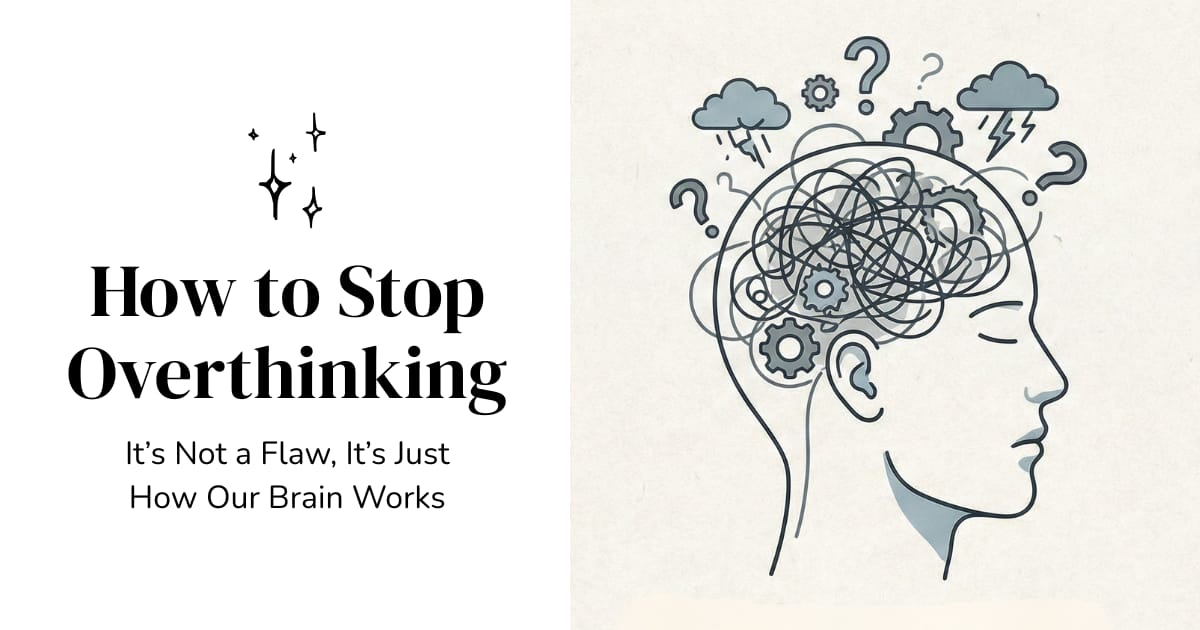
Ever find yourself lying awake at 2 AM, replaying a conversation from three days ago? Or spending your morning commute mentally rehearsing a meeting that hasn't happened yet? Maybe you've caught yourself scrolling through your phone, unable to stop even though you know it's making you feel worse?
If this sounds familiar, take a deep breath. You're not broken, anxious, or "too much." Your brain is actually working exactly as designed. The problem? It's running ancient software in a modern world it was never built for.
Why Our Mind Won't Shut Up
Here's something that might surprise you: research suggests we have between 12,000 and 60,000 thoughts per day. Most of these are repetitive, many are negative, and the vast majority don't deserve your attention at all.
Your brain was designed about 50,000 years ago when humans lived in small groups and faced immediate physical threats. Back then, the people who survived were the ones whose brains constantly scanned for danger, assumed the worst, and never quite relaxed their vigilance.
Sound familiar? 🤔
That hypervigilant survival brain is still running the show inside your head today. The challenge is that it can't tell the difference between a charging lion and a critical email from your boss. It treats your friend not texting you back with the same urgency as a genuine threat to your life.
This is why your mind gravitates toward what's wrong rather than what's right. It's why one criticism sticks with you more than nine compliments. It's why you can accomplish eight things on your to-do list but only think about the one you didn't finish.
This isn't a character flaw. This is your brain doing exactly what it was programmed to do over millions of years of evolution.
The Two Types of Thinking You Need to Know
Right now, as you read this, there are two completely different types of thinking happening in your mind.
Automatic thoughts are the running commentary that happens without any effort on your part. They're the mental note about something you need to do later, the random memory that just popped up, or the worry about whether you locked the door this morning. These thoughts arise involuntarily, often repetitively, and happen faster than conscious awareness.
Conscious thinking is completely different. This is thinking you deliberately engage in and control. It's purposeful, intentional, and aimed at achieving specific outcomes like solving problems, making decisions, or learning new information.
Most people spend very little time in conscious thinking. Instead, they spend most of their mental energy reacting to automatic thoughts, trying to analyze them or make them go away. It's like spending your entire day responding to spam emails instead of focusing on important work.
The tragedy is that we've been conditioned to believe every thought that enters our mind is important, true, or worth engaging with. But here's the truth that changes everything: just because you think something doesn't make it important.
The Space Between Stimulus and Response
Viktor Frankl, a Holocaust survivor and psychiatrist, wrote something profound: "Between stimulus and response there is a space. In that space is our power to choose our response."
This space is where your freedom lies. Without awareness of this space, your mental life looks like this: something happens → your brain generates automatic thoughts → you respond based on those thoughts. You're being controlled by the first mental reaction your brain produces.
With awareness of this space, everything changes: something happens → your brain generates automatic thoughts → you recognize these as automatic thoughts rather than facts → you pause → you respond based on conscious evaluation rather than automatic reaction.
The pause doesn't have to be long or dramatic. Sometimes it's just a single breath, a moment of recognition that says, "That's an automatic thought. Let me actually think about this consciously." This brief pause creates the space for choice, and choice is where your freedom lives.
Three Practical Ways to Stop Overthinking Today
1. Move Your Body 🏃♀️
Your brain literally changes when you move. Physical activity interrupts automatic thought patterns and grounds you in your body. When you're engaged in movement, especially activities requiring coordination or attention, your mind naturally shifts away from repetitive worries.
You don't need intense workouts. A 10 minute walk can shift your mood. Twenty minutes of gentle movement can significantly reduce anxiety. The key isn't intensity, it's consistency.
2. Breathe Consciously 🌬️
Your breath is the most accessible tool you have for changing your mental state instantly. When you breathe slowly and deeply, you're telling your nervous system that everything is okay and it can relax.
Try this simple technique: Inhale through your nose for a count of four. Hold for four. Exhale through your mouth for a count of four. Hold empty for four. Repeat for five rounds.
This creates balance and helps shift you from automatic reaction to conscious response.
3. Think on Paper 📝
When you try to hold too many thoughts in your head simultaneously, your thinking becomes muddled and your anxiety increases. Writing forces your brain to slow down and organize thoughts in a linear way.
Every morning, try a "brain dump." Sit down and write continuously for 10 to 15 minutes about whatever comes to mind. Don't edit, organize, or judge. Just write. This clears mental space and often reveals that worries feeling overwhelming in your mind appear much more manageable on paper.
The Most Important Truth
You are not your thoughts. You are the awareness that observes your thoughts.
When you identify with your thoughts completely, you feel compelled to react to every mental event. When you understand that you are the observer of your thoughts, you gain the freedom to choose which ones you engage with and which ones you let pass by.
Your mind will continue to generate unnecessary worries, imaginary problems, and unhelpful mental chatter. That's not going to change. But now you know why it does this, and that knowledge gives you the power to choose your response.
Your Mind Can Get Chaotic, But You're Not Your Mind
The goal isn't to eliminate all negative thoughts or achieve some impossible state of constant calm. The goal is to develop a different relationship with your thoughts, to become more selective about what you pay attention to, and to build simple practices that help you return to clarity when your mind inevitably gets noisy again.
Think of it like physical fitness. You don't go to the gym once and become permanently strong. You develop habits, build strength gradually, and accept that maintaining your health is an ongoing practice. Mental fitness works the same way.
You already have everything you need to succeed. You don't need special equipment, expensive courses, or years of meditation experience. You simply need to understand how your mind works and develop the skill of choosing which thoughts deserve your attention.
Some days you'll exercise your power of choice skillfully. Other days you'll react automatically and fall into old patterns. This is the nature of being human. Growth isn't linear, and setbacks aren't failures. They're opportunities to practice the skills you're developing.
Your mind will still run wild sometimes, and that's perfectly okay. The difference now is that you understand what's happening, you recognize the patterns, and most importantly, you know you have the power to choose your response.
And that makes all the difference. ✨
Ready to put these strategies into practice? Download the free 5-Minute Mental Clarity Workbook for a simple guide you can use immediately.
Disclaimer: This blog is for educational purposes based on personal experience and research. While this blog is meant to inform and inspire, this content is not a substitute for professional mental health advice. If you need professional help, please seek qualified support.